

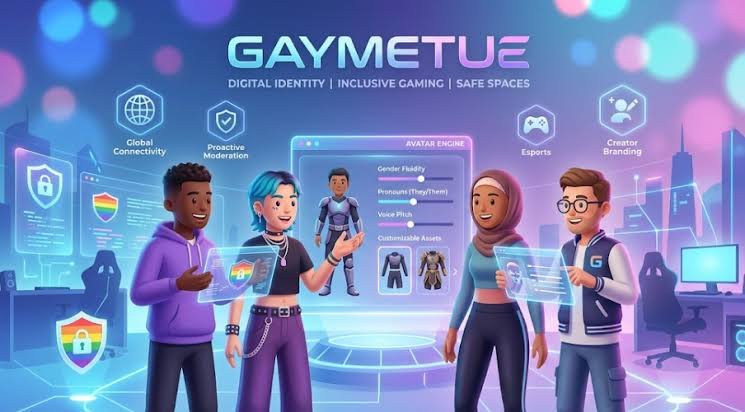
The gaming industry is undergoing a significant cultural transformation. What was once viewed primarily as a form of entertainment has evolved into a powerful social and creative environment where people build communities, express identities, develop relationships, and participate in shared digital experiences.
At the center of this broader shift is the emerging concept of Gaymetu E, which can be understood as a cultural framework connecting gaming, personal identity, digital self-expression, and inclusive online communities. Rather than representing one confirmed gaming platform or application, the term is increasingly discussed in relation to the changing ways people experience identity and belonging through interactive entertainment.
Understanding Gaymetu E
Gaymetu E is best approached as an evolving digital-culture concept rather than a conventional gaming product. It reflects the idea that modern gaming can be about much more than competition and achievement.
Players increasingly want the ability to customize their characters, tell different kinds of stories, participate in communities, and interact with people from a wide range of backgrounds. This has made representation and inclusion increasingly important aspects of game design.
The concept also reflects a broader transition from gaming as an individual pastime toward gaming as a social ecosystem. Online games can now function as meeting places, creative platforms, storytelling environments, and communities in which players develop aspects of their digital identities.
Why Inclusive Design Matters
Inclusive design is becoming one of the most important considerations in contemporary game development. It involves creating experiences that can accommodate players with different identities, cultures, abilities, backgrounds, and preferences.
One of the most visible examples is character customization. Allowing players greater freedom over appearance, body type, gender presentation, clothing, and other characteristics can provide a stronger sense of ownership over the gaming experience.
Research has found that customizable avatars can be particularly meaningful for transgender and gender-diverse players. Studies indicate that avatars can provide opportunities to explore identity and experiment with forms of self-expression that may be difficult to navigate offline. More recent research similarly associates customization with empowerment, enjoyment, and authentic self-representation.
This demonstrates that customization is not simply a cosmetic feature. For some players, it can influence whether a digital environment feels welcoming and authentic.
Representation Beyond Token Characters
Diversity in gaming should extend beyond simply adding characters from different backgrounds. Authentic representation requires meaningful storytelling, thoughtful character development, and participation from diverse voices during the development process.
Recent research on gaming culture has highlighted concerns about superficial or performative representation, in which diversity is included primarily for marketing purposes without creating meaningful changes to characters, narratives, communities, or development practices.
Successful inclusive design therefore requires more than visibility. Players should be able to see diverse identities represented as complex, multidimensional parts of the gaming world rather than as stereotypes or symbolic additions.
Building Safer Gaming Communities
Game design is only one part of creating an inclusive gaming environment. Community management and moderation are equally important.
Online gaming communities can expose players to harassment, discrimination, hate speech, and other forms of toxic behavior. Clear community standards, effective reporting mechanisms, consistent moderation, and meaningful consequences can help establish healthier environments.
A 2026 systematic review of inclusion in gaming communities emphasizes that effective moderation, codes of conduct, reporting systems, proactive education, and community engagement can contribute to safer and more welcoming gaming spaces.
This is particularly important for marginalized players, who may experience exclusion not because of the game itself but because of the behavior of other members of its community.
Gaming as a Space for Identity and Belonging
The importance of inclusive gaming extends beyond representation. Games can become environments where people explore who they are and connect with others who share similar experiences.
For LGBTQ+ players and other underrepresented groups, digital communities can offer opportunities for connection and self-expression. Avatars, usernames, virtual spaces, and social interactions can all contribute to the development of digital identity.
This does not mean that every gaming environment needs to become explicitly identity-focused. Rather, it suggests that players benefit when they are given meaningful choices about how they present themselves and interact with others.
Cultural Diversity Is Equally Important
Inclusion also means recognizing cultural diversity.
Gaming communities are global, yet many games have traditionally relied on a relatively narrow range of cultural perspectives. Research involving gamers in Pakistan, for example, suggests that culturally authentic narratives, community interaction, and culturally informed activities can strengthen players’ sense of belonging and emotional connection to games.
For developers, this creates an opportunity to move beyond generic representations of global culture. Local histories, languages, traditions, environments, and social experiences can all become meaningful elements of interactive storytelling.
The Role of Developers
Developers have an important responsibility in shaping the future of inclusive gaming.
Creating diverse games requires inclusive thinking throughout the development process. This can include consulting with different communities, hiring diverse creative teams, conducting accessibility testing, providing flexible customization options, and evaluating how characters and stories may be interpreted by different audiences.
An especially promising approach is participatory design, in which communities are actively involved in shaping the experiences intended for them. Recent work on queer game design, for example, emphasizes collecting community perspectives and incorporating them into game development rather than designing representation from a distance.
The Future of Gaymetu E
The future significance of Gaymetu E may ultimately depend less on whether it becomes a specific platform and more on whether the principles associated with the concept continue to influence digital culture.
Gaming is increasingly becoming a place where entertainment, identity, creativity, and social interaction intersect. As technologies such as artificial intelligence, virtual reality, advanced character customization, and real-time online communities develop, players are likely to have even more opportunities to shape their digital experiences.
The challenge will be ensuring that technological progress is accompanied by cultural progress.
The most successful gaming environments of the future are unlikely to be defined solely by graphics, performance, or technical innovation. They will also be judged by whether people feel represented, respected, safe, and able to participate.
Conclusion
Gaymetu E represents an emerging way of thinking about the relationship between gaming, identity, and community. While the term should not be confused with a verified standalone gaming platform, the cultural ideas associated with it reflect a genuine transformation taking place across the industry.
Inclusive design is becoming increasingly important because players are not simply consumers of digital worlds. They are participants who bring their identities, cultures, experiences, and expectations into those worlds.
The future of gaming will therefore depend not only on what developers create, but on who gets represented, who gets heard, and who feels that they belong.
As gaming continues to evolve, diversity and inclusion are moving from optional considerations toward fundamental elements of meaningful digital experiences.
Leave a comment